The Problem Isn't Your Circumstances. It's What You've Made Them Mean.
There's a version of you that has done everything right.
You've worked harder than most. You've shown up when you didn't want to. You've built discipline rooted in systems and a life that, from the outside, looks like it's working. And yet somewhere underneath all of it, underneath the calendar and the commitments and the performance, there's a quiet, persistent weight you can't seem to put down.
Not failure. Not a crisis. Just this: the sense that you're working harder than it should require. That something is always slightly off. That no matter how much you accomplish, the feeling you were chasing doesn't quite arrive.
Almost like all the external success and the internal system are barely enough.
You've probably told yourself it's a strategy problem. A focus problem. A motivation problem. Maybe you need a better plan. Better habits. A new and updated framework.
I want to offer you something different.
The Industry's Blind Spot
The performance world has built an entire economy around the idea that more is the solution.
More effort. More accountability. More optimization. More output. And none of it is wrong, exactly. Discipline is real. Systems matter. Execution is necessary. Accountability does work, and works well.
But here's what the industry rarely asks: what is driving the effort, the desire to optimize your entire life, and the need to succeed?
Because here's what I've watched happen, session after session, with high performers, founders, executives, and athletes at every level of achievement: the effort isn't the problem. The unconscious force behind the effort is what creates the problems.
When you run harder from a place of not enough, you don't arrive at enough. You arrive at exhausted...and still not enough. Just further weighted with evidence that you need more. When you discipline yourself from a place of fear, the discipline reinforces the fear. When you optimize your circumstances from a place of survival, you get better circumstances and the same inner experience of running unconsciously from something.
This is the invisible architecture most coaching never touches.
The conventional model works in what I call the 3D world of change: circumstances, behaviors, results. Change the behavior, change the result. Change the result, change the circumstance. If none of it works, try harder, blame the circumstances, or keep searching for the next hack or shortcut. It's logical. It's measurable. It's not bad or wrong....AND it's incomplete.
Because sitting upstream of every behavior, every result, and every circumstance you're trying to change is a 5D world that is almost entirely invisible to you: your identity, your perception, your interpretation, your state of being, your mindset. The 5D world is the operating system of empowerment. The 3D world is just the output that can be seen. A canvas of the 5D, if you will.
And if the operating system is running on survival code, built from the experiences, losses, voids, and adaptations of a much younger version of you, then no amount of optimization downstream is going to change what's generating it.
What I Keep Seeing
I've sat with people who had everything performing and still felt hollow.
People who hit their financial goals and immediately moved the target. People whose anxiety didn't decrease as their success increased; it grew with it, because more success meant more to lose.
I've sat with a founder who couldn't figure out why he kept undercharging for his work, why every new opportunity felt slightly too good to be true. Not because the opportunity wasn't real, but because somewhere in his formation, he'd absorbed a belief that things working out meant something was about to go wrong. The belief wasn't in his calendar or his pricing strategy; it was in his blind spot, his identity.
I've sat with a high performer who identified the source of her anxiety as her circumstances: too much to do, not enough time, reactive clients, an unpredictable income. But when we sat with it long enough, what emerged was something she hadn't seen before: that the chaos wasn't happening to her. She was, unconsciously, generating it because stillness felt unsafe. Because if she wasn't solving something, she wasn't valuable. Because "being" had never been enough, only doing had ever earned her a place.
I've sat with an athlete convinced his performance plateau was technical. Wrong equipment. Wrong approach. Wrong preparation. Wrong diet. Wrong workout plan. And when we finally stopped working on what he was doing and started asking who he was being when he competed, what we found was this: he'd built his entire identity on a version of himself that had to win in order to belong. He loved winning, but losing felt like proof of something shameful. The sport wasn't the problem. The meaning he'd attached to performance was creating it.
In every case — without exception — the circumstances were not the source of the problem.
The perception of the circumstances was.
You're Not a Victim of Circumstance. You're a Victim of Your Perception of Circumstance.
I want to be clear: this isn't a judgment. It's an observation, and one of the most liberating perspectives available to you once you're ready to receive it.
Because if your circumstances are the problem, you are at their mercy. You need them to change before you can feel different. You need the revenue to hit, the relationship to stabilize, the team to perform, the body to cooperate before the weight lifts.
But if your perception is the source, if what's actually running you is the meaning you've assigned to what's happening, then you have agency that no circumstance can take from you.
Your circumstances aren't creating your experience. Your identity is creating your perception of your circumstances, and that perception is creating your experience.
This is not a motivational reframe. It's a structural truth about how human beings operate. The neuroscience, the epigenetics, the psychology; they all point to the same place: we don't see the world as it is, we see it as we are.
And who we are was largely decided before we had the awareness to choose.
Where It Actually Comes From
Most of the invisible architecture running your performance was built between the time you were born and your teenage years.
Before you had language for it, before you had context for it, you were watching the world and making decisions about what it meant. About what you had to be to be safe. About what earned love and what lost it. About whether the world was generous or threatening. About whether you were enough.
Those decisions didn't disappear when you grew up and got successful. They went underground. They became the lens. And now they're running your leadership, your relationships, your financial patterns, your ambition; and you're calling it "strategy" and calling perfectionism "high standards" when it's the younger version of you, scared to be seen as human.
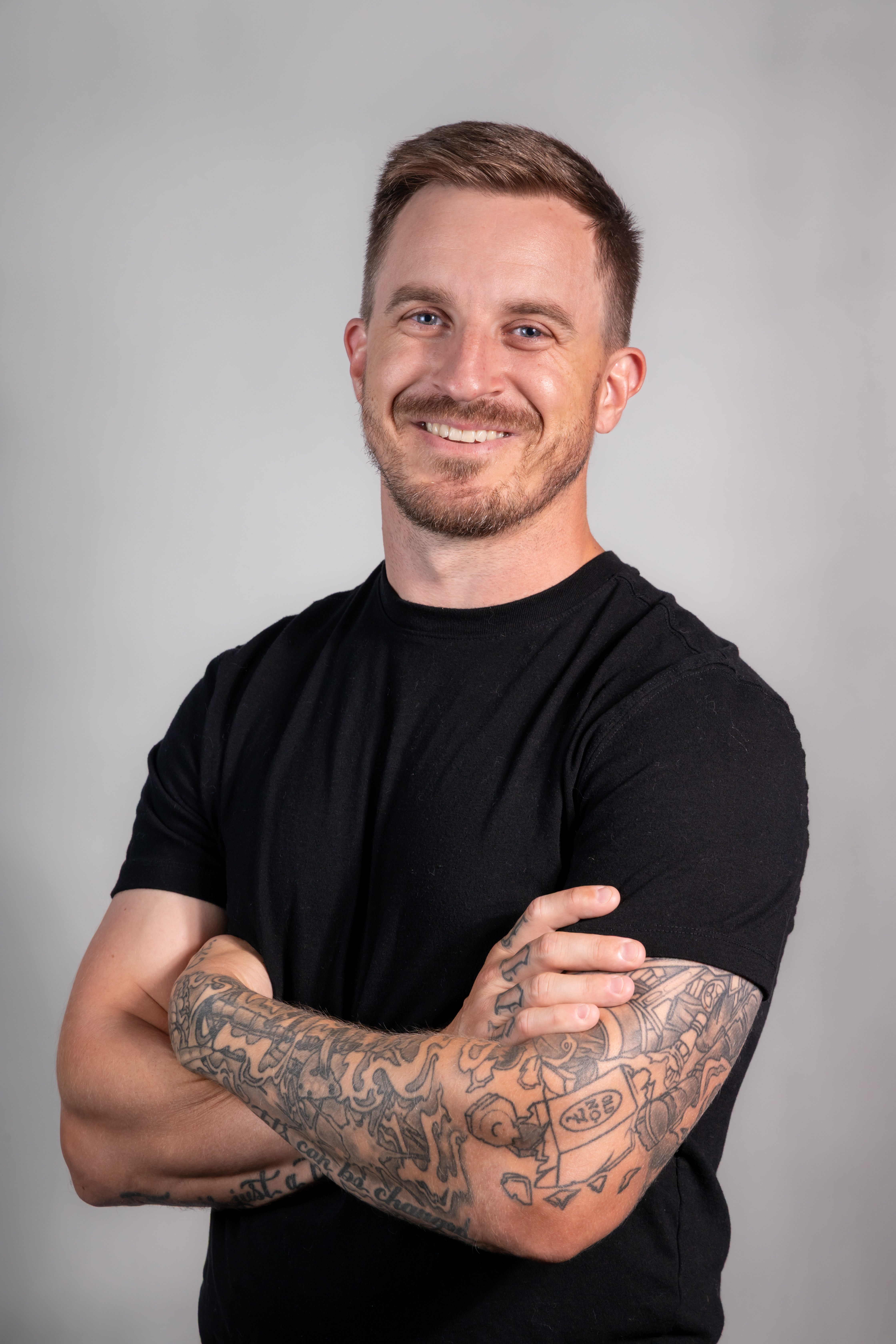
I walked away from professional BMX at 31 after competing at the highest level for over a decade. From the outside, it looked like a choice. From the inside, I was exhausted in a way that had nothing to do with the sport. I had built an identity entirely around performance, around proving, around being someone whose value was measured in what he could do under pressure. Five brain tumors and an awake brain surgery later, I wasn't just rebuilding my health. I was confronting, for the first time, the architecture underneath everything I'd built.
What I found wasn't weakness. It was a survival system that had been extraordinarily effective, and was now quietly running the show in ways I couldn't see.
That's what I work with now. Because it's more than a compelling story, it's the only work that actually changes anything at the root.
What Changes When You Go Here
When a client dissolves a core identity belief- not manages it, dissolves it- something shifts that no habit or system produces.
The effort becomes lighter because they're doing less and they're no longer working against themselves. The force becomes flow. The discipline stops being a punishment and becomes an expression of who they actually are.
The circumstances don't always change immediately. But the experience of the circumstances changes completely. Because the meaning changes. And the meaning was always the thing.
This is what I mean when I say the work is upstream. And it's why I've stopped being interested in helping people perform better from the same identity. The performance coaching conversation is a decade behind the science, behind the psychology, and behind what the highest performers I know are quietly discovering on their own:
That the invisible world- identity, perception, interpretation, state, mindset- is not soft; it is not supplementary; it is the source.
Everything else is downstream.
The Question Worth Sitting With
If you've read this far, something in it landed. Maybe you recognize the exhaustion. Maybe you recognize the pattern of hitting goals and still not arriving. Maybe you recognize that the story you've been telling yourself about what's in the way isn't quite the whole story.
I want to leave you with one question; not to answer right now, but to sit with honestly:
What have you made your circumstances mean about you?
Not what your circumstances are. What have you made them mean? About your worth. About your potential. About what's possible for you and what isn't.
About why you can't ________.
Because that meaning, not the circumstances themselves, is what you're actually living inside of.
And meaning, unlike circumstance, can be changed in a split second.
Josh P. 💚🧠✌🏼
Comments